Soil Health Principles 4
Living Roots
Margit K. , Agriculture Agent
Without a doubt, Living Roots are the ‘sine quo non’ for Soil Health. ‘Sine quo non’ is a great Latin term, meaning ‘without which not’, or ‘without which nothing’, that refers to an essential, indispensable condition or quality. It is used to describe something that is absolutely necessary for something else to exist or happen. In this case, living roots, and by extension - living, green, photosynthesizing plants – are the essential vital element to stimulating and increasing soil health! Without living roots we’ll have nothing. As evidenced by 4.6 – 6.7 billion tons of soil lost across the United States annually, and nearly 60 billions tons lost in the Midwest alone – since the 1930’s due to soil wind and water erosion.
Of all the Soil Health Principles – without living roots, none of the other principles can exist or function well. Without green, photosynthesizing plants a farm’s context is going to look far different…bare, dry, compacted soil, devoid of soil microbiological function, or biological diversity – whether above ground or below ground. It’s well understood that No-Till agriculture without living roots (cover crops) can still result in heavy compaction, poor aggregate stability, reliant on chemical weed control that may damage the soil microbiome and exposed soil prone to erosion. Based on the previous principles covered thus far (context, minimizing disturbance, and armoring the soil), living roo
ts are the driver of both soil structure (water stable aggregates) and proper ecological soil function (water, and nutrient cycling).
I love the way Dr. Christine Jones describes plants as ‘Soil Symbionts’. If we look at a plant in its purest essence – it is a symbiotic organism – living in intimate relationship with the soil organisms that surround its roots, as well as the multitude of organisms above ground which benefit from its fibers, flowers, pollen, fruits, seeds, etc.
Through photosynthesis, the plant captures sunlight (photons) and transforms them with water and carbon dioxide through their chlorophyll to create simple carbohydrates (glucose), C6H12O6. Thus, Carbon dioxide, (CO2), is transformed into liquid carbon through the plant leaf, and deposited through living roots - into the soil…deep down as far as the roots go! You can begin to see why the tallgrass prairie, with root systems downwards to 20-30 ft, built upwards of 6 – 8 ft of black carbon-rich ‘topsoil’ deposits over millennia across the entire Great Plains.
Why deep down? Why are plants pumping simple sugars deep down into the dark mineral rich soil? What’s to be gained? We used to think the water reserves in the soil were responsible for solubilizing rock mineral deposits and that’s how plants were gaining mineral fertility. Yes, water plays an important role in plant health, cytoplasmic streaming in plant tissues and nutrient cycling, without a doubt. But as for accessing mineral fertility the theories of plant nutrition were totally debunked by the revolutionary discovery of Plant Rhizophagy in 2014,(*see side article).
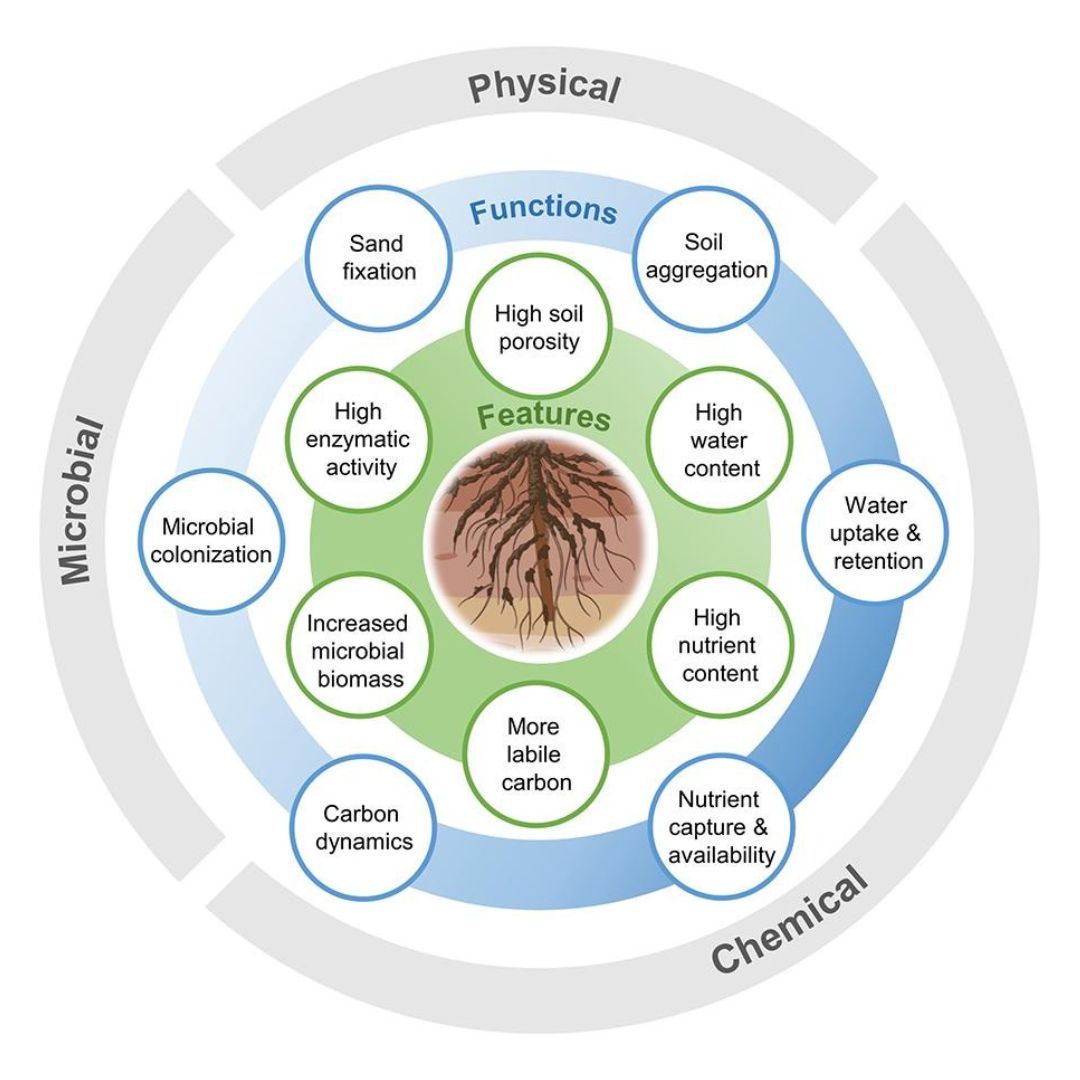
What we observe as liquid carbon sugars (glucose), are released along with other plant metabolites through root tips, as ‘root exudates’, (combined with Plant Rhizophagy) is an new understanding of plants operating at a higher order of ‘intelligence’ than previously understood. Plants can be seen as a ‘soil symbionts’ by the manner they ‘feed the soil’ (purposeful extracts) to be ‘fed’ by the soil microbiome. Not only are the plant root exudates the primary energy source for the infinitesimal microbiome (bacteria, algae, archaea, protist organisms and mycorrhizal fungi) living in the soil, the sugars are themselves are also partly responsible for contributing the ‘glue’ that builds water stable aggregates in the soil, as roots grow downwards.
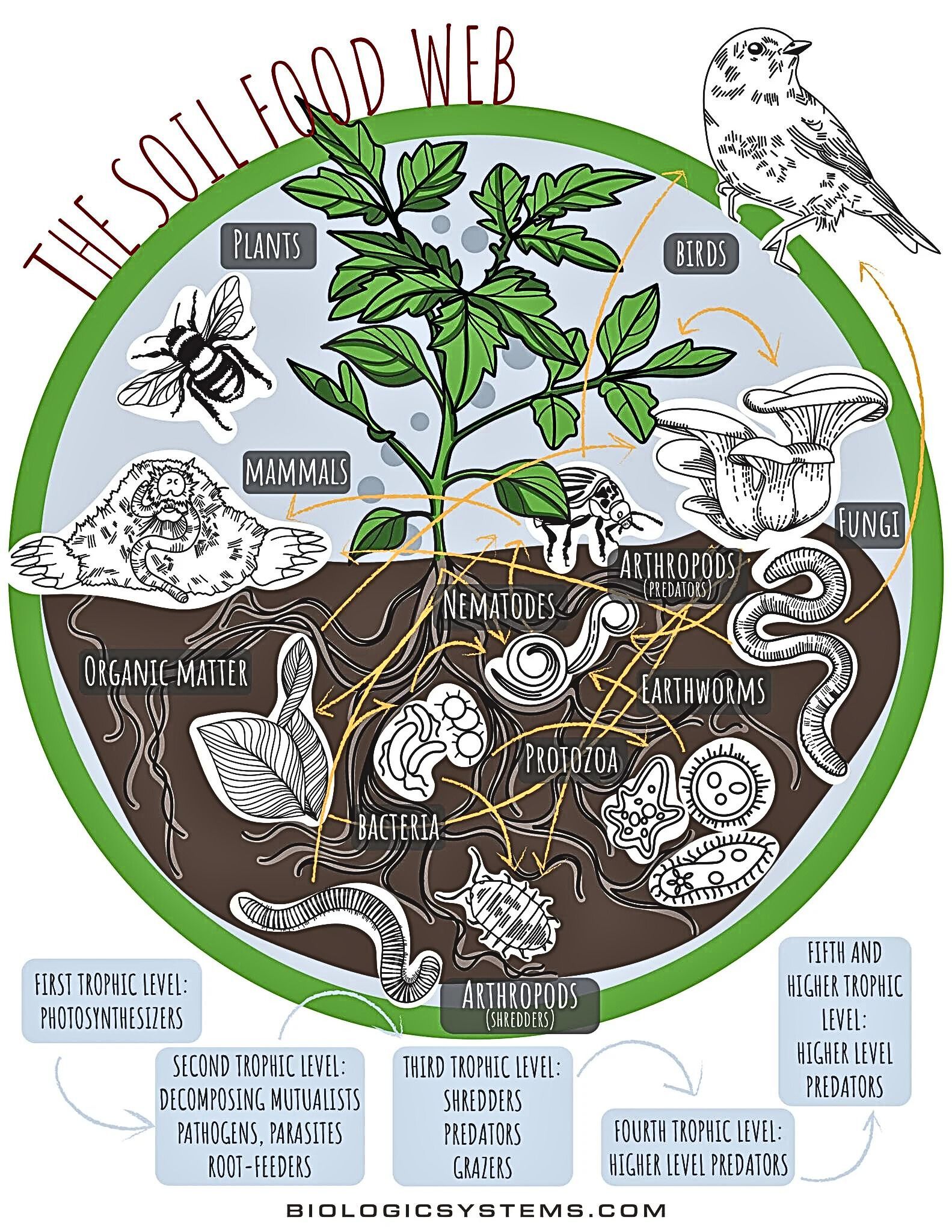
The entire soil microbiome, and soil ‘food web’ , as revealed across all the trophic levels – from mycorrhizal and saprophytic fungi, simple, single cell organisms to the higher order, ciliates, protozoa, arthropods (insects including earthworms and mammals) - are all dependent upon the plant root exudates released by living roots.
New science reveals plants signal specific microorganisms, via living roots, essential exudates necessary for those microorganisms, to acquire those soil mineral elements the plant needs! Symbiosis. Nature’s mutualistic economy. Microbiologists can begin to identify the specific role or ‘soil function’ certain groups of organisms play – as they dissolve, digest, transform and/or ‘mine’ specific soil minerals after feeding on the plant exudates. As plant root exudates feed this army of microscopic soil engineers, they in turn, bring essential mineral nutrients back to the plants via plant rhizophagy, or are indirectly consumed by higher order organisms that release the mineral nutrients in a plant-available form, as excreta. For soil health to flourish, living roots are truly the foundation, that leads to water stable aggregates, building increased soil organic matter and cation exchange capacity, ideal pH, neutralizing effects of plant root acids, increased water infiltration, aeration, and a plethora of other benefits. Follow on to read about Plant Rhizophagy – and why the myth of plants being ‘vegetarian’ has been dispelled as well.
Resources
SARE - Farming with Soil Life Article - Webpage
SARE - Our Living Soil Article - Webpage
This article is from the 2025 K-State Extension Douglas County Winter Newsletter publication.