Those Beautiful Fall Colors
The Science Behind it All
Sharon A., Horticulture and Natural Resources Agent
The warm night-time temperatures this October and November may have muted some of our fall colors, but I still find stunning shrubs and trees as the leaves give their curtain call for the year. How is it that we get to enjoy this change of scenery each fall?
Molecules in the leaves called pigments absorb light of different wavelengths. Remember the color spectrum from school using the acronym ROY G BIV (red, orange, yellow, green, blue, indigo, violet)? Chlorophyll, the primary pigment in leaves absorbs the red, orange, and yellow wavelengths along with the bluer pigments and reflects the green wavelength. This is why most leaves appear green to us. Other common pigments involved in fall color include anthocyanins (reflect red and purple), xanthophylls (reflect yellow), and carotenoids (reflects orange).
Chlorophyll, carotenoid, and xanthophyll pigments absorb light and produce sugars for plant growth during the growing season. Anthocyanins are not involved in photosynthesis but help protect the plant from herbivory and ultra-violet light. As the nights get longer chlorophyll production slows, eventually stops and the chlorophyll molecules break down. The fluid being transferred in and out of the leaves (water, nutrients, and sugars) also slows and a layer of cells form at the base of the petiole, where the leaf attaches to the stem. This layer of cells is called the abscission layer and it eventually seals off the leaf from the stem, causing the leaf to fall from the tree. As the abscission layer is forming, sugars are trapped in the leaf and promote the development of the anthocyanins. The degradation of the chlorophyll molecules and the buildup of the anthocyanins gives us the beautiful colors of autumn.
Temperature and moisture during the fall affect the intensity of the colors we see. Warm, sunny days produce a lot of sugars while cool nights during the formation of the abscission layer trap those sugars in the leaf. Drought stress will reduce the formation of sugars.
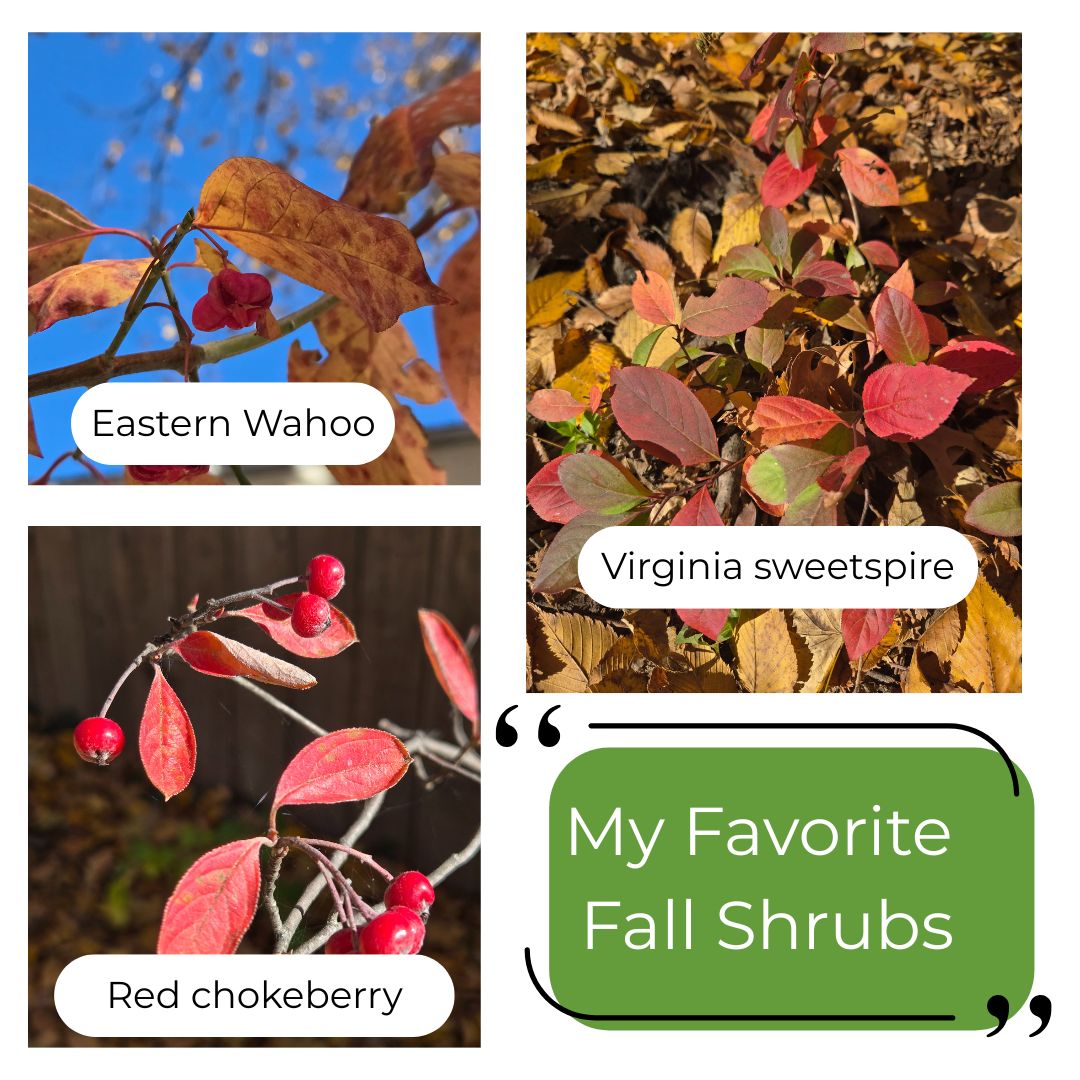
Here are some favorite shrubs I’ve planted in my yard for beautiful fall color.
Golden currant (Ribes odoratum) - Golden currants also have beautiful yellow blossoms in the spring that smell wonderful.
Strawberry bush (Euonymus americanus) - A shade tolerant shrub with gorgeous bright red and orange seed capsules.
Eastern wahoo (Euonymus atropurpureus) - A small, native understory tree with a unique seed capsule to go with its red/orange/yellow leaves.
Virginia sweetspire (Itea virginica) - A small shrub with lovely white flowers in the spring.
Red chokeberry (Aronia arbutifolia)- Bright red berries in the fall. Also consider black chokeberry (Aronia melanocarpa) to attract birds.
References
US Forest Service: https://www.fs.usda.gov/fallcolors/2018/science.shtml
Missouri Botanical Garden Plant Finder: https://www.missouribotanicalgarden.org/plantfinder/plantfindersearch.aspx
Chicago Botanic Garden (download a leaf coloring activity): https://www.chicagobotanic.org/fall/coloring
This article is from the 2025 K-State Extension Douglas County Winter Newsletter publication.