Soil Health Principles 4 - Living Roots pt. II
By Margit Kaltenekker, Agriculture Agent
This series of articles addresses Soil Health Principles first articulated and advanced by Natural Resource Conservationist Jay Fuhrer of Menoken Farm in North Dakota. These principles have since been widely adopted, refined, and expanded upon by regenerative farmers and ranchers across the country and now commonly include: Context, Minimizing Disturbance through Reduced Tillage, Covering and Armoring the Soil, Living Roots, Biodiversity, and Integrating Livestock.
We addressed Living Roots in the Winter issue where we discussed plants as a ‘Soil Symbiont’ — ‘farming’ microbes through carbon rich root exudates in exchange for minerals. But there is more to say about the essential role living roots play to ensure soil stable-aggregates, increased organic matter and a biodiverse soil food web.
Let’s dig a bit deeper to compare perennial and annual cropping systems, explore reasons for maintaining living roots year-round, and examine the soil health benefits of doing so.
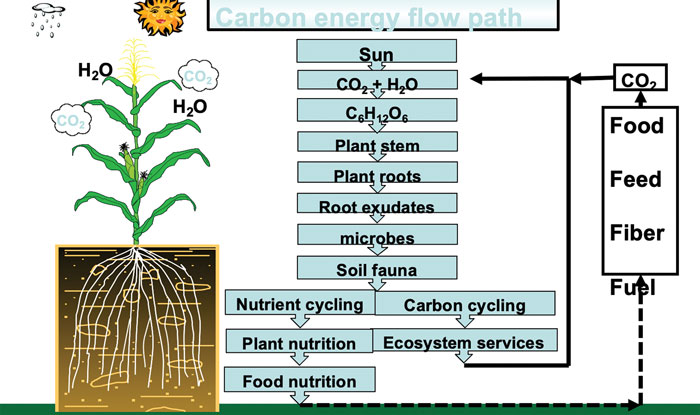
Perennial ecosystems — whether grasslands, forests, orchards, or hayfields — typically include a mix of cool- and warm-season grasses and forbs. These plants are adapted to spring and fall growth as well as intense summer heat, resulting in nearly continuous photosynthesis. Sunlight is converted into carbohydrates through what is often called the “liquid carbon pathway,” feeding both the plant and the soil microbial community throughout the year.
By contrast, annual cropping systems grow either cool- or warm-season crops that remain in the soil for only a few months. They are often followed by extended fallow periods before the next rotation. In many cases, the fallow window (~8 months) is significantly longer than the active growing season (~4 months). As discussed previously, leaving soil exposed during these periods can starve microbes of carbohydrates, leaving the microbial community no choice but to digest and breakdown organic matter, increasing the risk of wind and water erosion.
Cover crops — along with more diverse crop rotations (addressed in the next article) — are among the most effective tools to “close the gap” during fallow or dormant seasons. They provide a continuous supply of root exudates — or “liquid carbon” — the primary food supply for the soil food web.
The Real Reason for Living Roots
Why does this matter?
At its most fundamental level, agriculture is the conversion of a free primary resource — sunlight — into a marketable product. Through photosynthesis, farmers and ranchers transform solar energy into “solar dollars.” Whether sunlight becomes forage, fed through an animal, carrots sold wholesale, or grain harvested for market, the principle remains the same: why leave land dormant when we can maximize the return per acre through continuous living cover — building livestock, crop yield, or long-term soil carbon reserves that buffer against drought?
Benefits of Living Roots
While crop residues provide fuel for saprophytic fungi and other decomposers, living roots actively infuse the soil with energy in the form of carbon, (complex carbohydrates) — driving the soil microbiome toward greater function and resilience.
Living roots:
- Convert atmospheric CO₂ into carbohydrates that feed nitrogen-fixingand phosphoroussolubilizing bacteria, archaea, mycorrhizal fungi, and other microorganisms
• Stabilize soil aggregates and pore spaces, improving infiltration
• Capture and cycle nutrients, improving water quality - Help moderate salinity (electrical conductivity) associated with high-salt fertilizers
• Increase pollinator habitat and overwintering cover
• Reduce weed pressure through improved aeration and soil tilth
• Enable livestock integration
• Add crop diversity
• Provide food and habitat for wildlife
• Influence carbon-to-nitrogen ratios, affecting decomposition rates
• Build long-term carbon reserves — the sine qua non of agricultural resilience
That final point gets to the root of why soil health demands year-round living roots: carbon. Whether described as root exudates, carbohydrates, sugars, or simply carbon — carbon is black gold in a living soil. Whether labile carbon – easily digested and cycling in the top 6 inches of soil as a source of energy, over days or years, or non-labile/ stable carbon, persisting in soil as deep carbon reserves over centuries. Living roots help ensure land remains productive, even during seasonal dormancy.
Putting It into Practice
Producers advancing regenerative agriculture, plan to extend the ‘growing season’ — by ordering diverse cover crop seed mixes before they are needed and intentionally integrating them into rotations to fill dormant windows. Many are incorporating livestock into crop fields (for example, grazing warm-season annuals following wheat), diversifying cropping systems, and making measurable reductions in fertilizer and pesticide inputs in turn.