Build a rain garden to enliven your landscape and protect our streams and rivers
Sharon Ashworth, Horticulture and Natural Resources Agent
During recent rain events, you may have noticed a spot in your yard where water collects, or the soil is especially soggy. That might be a good spot for a rain garden. Do you notice an area where water rushes off your property, or that the tail end of your downspout is a problem area? Those might be good spots for a rain garden.
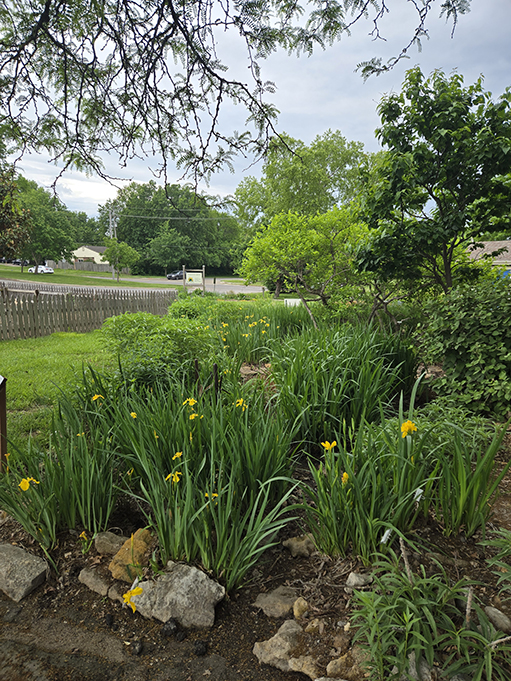
Rain gardens are shallow depressions in the landscape that capture stormwater and allow it to slowly soak into the soil. That captured rainwater helps keep the landscape moist, reducing the need to water with expensive, treated tap water. Rain gardens also prevent stormwater from rushing across the landscape, stripping soil and mulch from around plants, and carrying it all to the storm sewer or creek.
Rain gardens strategically placed to accept stormwater runoff from parking lots and other paved surfaces not only capture water but also the “stuff” washed off the pavement with the water. Sediment, the biggest pollutant in our waterways, will settle in the rain garden basin when the water carrying it is slowed down. Oil, gas, fertilizers, pesticides, and pet poop from concrete surfaces are also captured by the rain garden. These pollutants adhere to sediment particles washed off the pavement or are captured by the soil in the rain garden. Once captured, many pollutants are taken up by plant roots, so any outflow from the garden contains far fewer pollutants.
Rain gardens that capture a lot of sediment do need to be cleaned out regularly. Larger rain gardens are sometimes built with a forebay – a deeper basin where water first enters the garden and sediment is captured. Sediment removed from rain gardens that filter runoff from concrete surfaces, such as parking lots, should not be placed back on the landscape and should be disposed of with the regular trash or taken to a waste facility.
Plants suitable for rain gardens are tolerant of wet conditions and are often different than those typically planted in a home landscape. Plant diversity attracts pollinators, and temporary water storage attracts birds and other wildlife.
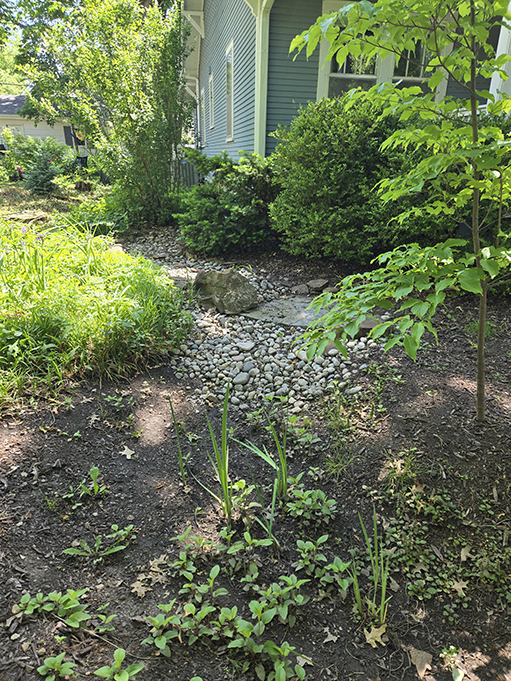
Recommended native plants for sunny rain gardens include blue stars (Amsonia spp.; attract bumblebees and hummingbird moths), sedges (Carex spp.; support skipper butterflies), Iris spp. (blue flag and copper), swamp milkweed (Asclepias incarnata; supports monarch butterflies), and rose mallow (Hibiscus laevis; attracts a wide range of pollinators).
Recommended native plants for rain gardens in part shade include palm sedge (Carex muskingumensis), golden ragwort (Packera aurea; early spring nectar source), blue lobelia (Lobelia siphilitica; attracts bumblebees), Cardinal flower (Lobelia cardinalis; attracts hummingbirds), Eastern bluestar (Amsonia tabernaemontana), and rose turtlehead (Chelone obliqua; attracts bumblebees and hummingbirds).
Below are links to details on constructing a rain garden and to two K-State Extension publications on water conservation and stormwater management. Rain gardens should drain within 24-48 hours, so sizing and conducting a percolation test are important steps.
Please visit the rain garden at the Extension office. I’d be happy to show you around!