The Sound of Summer
Sharon A., Horticulture & Natural Resources Agent
Listen to the song of the common Kansas dog day cicada, Neotibicen pruinosa.
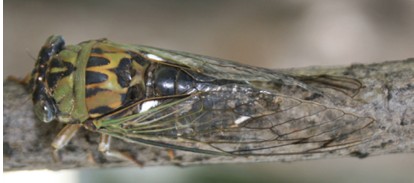
The sound of the cicadas is as much a part of Kansas as sunflowers and meadowlarks, and their call in the dog days of summer seems to add several degrees to the temperature outside. The dog day cicada is a common reference to several species of annual cicadas in the genus Neotibicen. Annual cicadas live as nymphs underground for two to five years, so there is a group emerging each summer. What are they doing underground? They are sucking on the sap of plant roots, but don’t worry, they rarely do any damage to the plant.
When mid-summer soil temperatures are steady, nymphs emerge from underground over the course of several weeks. A typical sighting of a cicada nymph is an empty brown shell clinging to a fencepost, a tree, or the wall of a building. Adult males “sing” by contracting and relaxing membranes called tymbals, located under their hind legs. Not only does the song attract a mate, it also attracts predators. Cicadas are a favorite seasonal snack for many birds (and my cat, though she mostly just wants to make them buzz!).
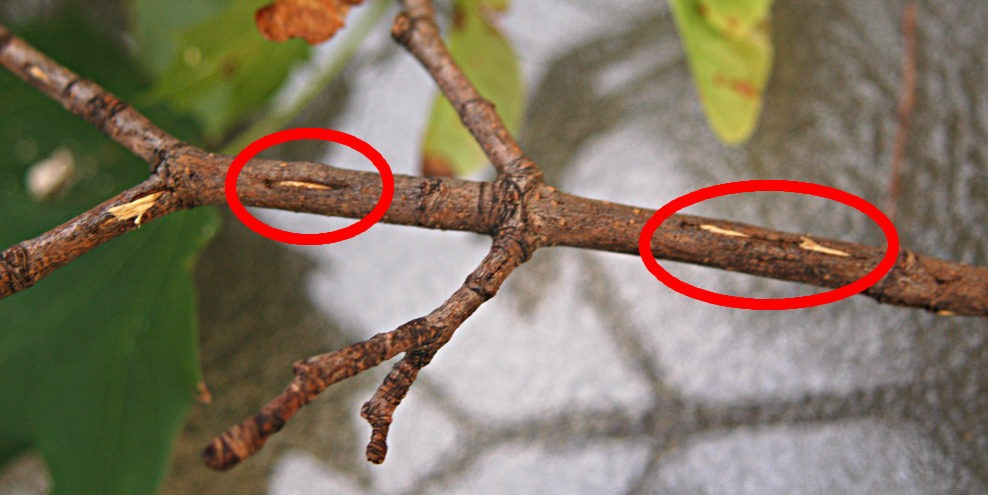
After the adults mate, the female cicada will use her ovipositor to cut a small slit in the smaller branches of trees and lay eggs, which will hatch and fall to the ground to start the cycle over again. Cicada egg-laying can cause a branch to die and break off, but it will rarely harm the tree. Out in the prairie, cicadas lay their eggs in the stems of sturdy perennial plants.
Annual cicadas don’t get the same press as the more dramatic species of periodical cicadas, which only appear every 13 to 17 years. Here in Douglas County, we have Brood IV of the 17-year cicada (Magicicada spp.) whose next emergence will be in 2032. Mass emergence of periodical cicadas can damage trees, and young trees may be killed when numerous females lay their eggs on multiple branches.
Some people are afraid of cicadas, thinking that such a large bug will have a large bite, but they are harmless. It’s the cicada killer that generates real fear.
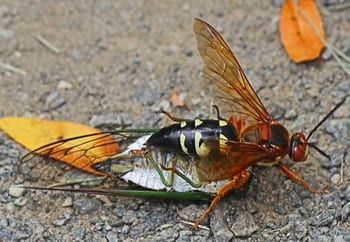
Cicada killers are frighteningly large, solitary wasps. However, the males cannot sting, and the females will only sting if harassed, stepped on, or grabbed. The female cicada killer will paralyze a cicada, drag it back to her nest, and lay her eggs on the cicada. The helpless cicada serves as food for hatched cicada killer larvae. Cicada killer nests appear as 1-inch diameter, 6 to 10-inch deep holes in your lawn. The holes are surrounded by excavated soil. Male cicada killers will guard the nesting area from other male cicada killers and may appear to challenge human invaders, but again, they are harmless and will go about their business as you go about yours.
Great Plains Nature Center: Kansas Cicadas
K-State: Cicada Killer
The Nature Conservancy: Everything you need to know about periodical cicadas