Extension Community Food Systems Team: Reducing Friction Between Tiers of the Food System
Quinlan Carttar, Food Business Resource Navigator
Across Kansas, the Extension Community Food Systems Team continues to ask an important question: How do we strengthen the relationships that make local and regional food systems work?
The answer, increasingly, is not just more information — it is more connection.
The graphic accompanying this article illustrates the different “tiers” of the food system, from personal food production and direct-to-consumer sales, all the way to large-scale aggregation and global distribution. Much of Extension’s work naturally centers around Tier 1: producers selling directly to consumers through farmers markets, farm stands, and community-supported agriculture. But some of the most important — and often overlooked — work happens in Tier 2: the strategic partners who help producers succeed.
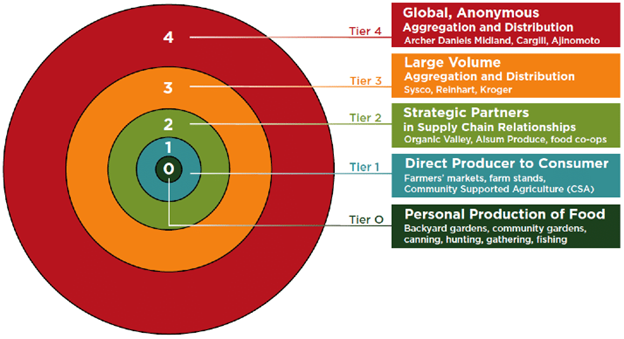
These are the organizations and individuals building infrastructure, coordinating logistics, creating market access, and supporting entrepreneurship in communities across the state. They are the connectors of the food system. And our team has increasingly focused on reducing friction between these tiers — helping people find one another, learn from one another, and move their work forward together.
This spring, that work takes shape through two new peer groups launching across Kansas. In May, the Farmers Market Peer Group will begin convening market managers and volunteers from across the state. In June, a new Shared Kitchen Operator Peer Group will launch, bringing together operators of licensed, commercial and community kitchen spaces serving food entrepreneurs and producers.
Both groups are built around a simple recognition: while market managers and kitchen operators spend their time supporting growers, makers, and small businesses, they themselves often lack structured peer support. Many are solving complex operational, regulatory, staffing, and community engagement challenges in relative isolation — the “wild west” of emerging food systems infrastructure.
These peer groups create space for participants to connect with others who understand those realities firsthand. Through facilitated discussions, shared troubleshooting, and relationship-building, participants can exchange ideas, identify common challenges, and build stronger support networks across communities. And because these groups are grounded in peer learning rather than top-down instruction, every participant brings valuable experience to the table.
Both communities of practice are still accepting new members, and anyone interested in joining is encouraged to reach out. The strength of these groups comes from the diversity of perspectives and experiences represented within them.
This same philosophy also shaped the Food Business Start-Up Summit, returning to Lawrence this August after a successful inaugural event last fall.
The summit was born out of a guiding question for our team: How do we create environments where people are not just receiving information, but actively building relationships, problem-solving together, and advancing their work in real time?
Before the event, participating food and farm businesses were extensively surveyed about their actual barriers, growth opportunities, and operational challenges. Rather than designing the agenda around what organizers thought entrepreneurs needed, the summit was built backward from the realities participants identified themselves.
Those responses directly informed which experts, technical assistance providers, lenders, manufacturers, and supply chain partners were recruited into the room. The event culminated in one-on-one consultations between entrepreneurs and key informants, leading to highly practical conversations around regulations, financing, manufacturing, distribution pathways, and business development.
For many participants, simply gaining direct access to people they otherwise would not know how to reach proved transformative.
That, perhaps, is one of Extension’s most important emerging roles in community food systems work: convener, connector, facilitator, and infrastructure-builder. By intentionally creating spaces where relationships can form across tiers of the food system, we help reduce friction between communities and systems — and strengthen the networks that allow Kansas food and farm businesses to thrive.
Reference for Graphic: Local Food Systems in Missouri: An Introduction. - Scientific Figure on ResearchGate. Available from: https://www.researchgate.net/figure/The-tiers-of-the-food-system-range-from-homegrown-foods-to-globally-distributed-foods_fig1_324950235 [accessed 19 May 2026]